
…As FNS Holds 4th Biennial Int’l Conference
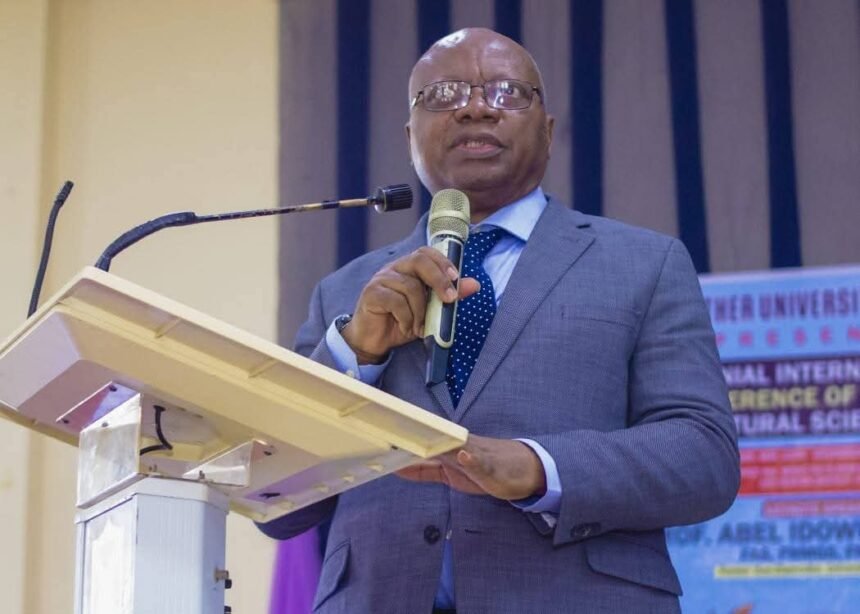
Prof. Abel Idowu Olayinka, a former Vice-Chancellor of the University of Ibadan (UI), has called on Nigerian universities to rethink their approach to research, shifting from the pursuit of knowledge for its own sake to a model that drives economic development, job creation, and societal transformation.
The charge came during the keynote address at the 4th Biennial International Conference of Natural Sciences, held at Ajayi Crowther University (ACU), Oyo, under the theme: “Frontiers in Science and Technology: Innovations for Sustainable Development in a Dynamic World.”
- …As FNS Holds 4th Biennial Int’l Conference
- Prof. Abel Idowu Olayinka, a former Vice-Chancellor of the University of Ibadan (UI), has called on Nigerian universities to rethink their approach to research, shifting from the pursuit of knowledge for its own sake to a model that drives economic development, job creation, and societal transformation.
Delivering the keynote address at the event organised by the Faculty of Natural Sciences (FNS), Prof. Olayinka argued that 21st-century research must deliver tangible economic benefits and improved quality of life. According to him, “The real and legitimate goal of the sciences is the endowment of human life with new inventions and riches,” adding that universities must function as engines of growth, centres of innovation, and agents of wealth creation.
Prof. Olayinka, who was the 12th substantive Vice-Chancellor of UI, presented a triangular model linking science at the centre with innovation, sustainable development, and entrepreneurship at the edges. He stressed that sustainable development requires entrepreneurial initiatives capable of addressing environmental challenges, fostering social inclusivity, and promoting responsible economic practices.
He noted, however, that most Nigerian universities lack clear mechanisms for setting research agendas, leaving academics to conduct disconnected individual research in silos. Other challenges listed by Prof. Olayinka include excessive teaching loads, external consultancies, and poor linkages with social demands and national development priorities.
“Research at most universities competes with high teaching loads and external demands such as consultancies and teaching at private institutions. This leaves little time and energy to devote to doctoral students,” Olayinka warned. “The application of research results remains one of the major weaknesses because linkages with social demands and national development priorities are rare, if not non-existent.”
To reverse the trend, the former UI Vice-Chancellor recommended that universities establish intellectual property (IP) policies, technology transfer offices, and research integrity units. He also called for continual upgrades to research infrastructure and the creation of new governance models for university research.
“In our technological, knowledge-driven world, change is inevitable. Our strategic research must contribute to local, national, and global development,” he said, adding that university spin-off companies, which are now common in developed countries, can help commercialise research results and encourage entrepreneurship.
In a sharp takeaway, Prof. Olayinka posed a pointed question to the audience, asking, “Will Nigeria chart its own path to development across these game-changing spaces, or will it remain a dumping ground for finished products, wallowing in consumerism?”
Declaring the conference open, the Vice-Chancellor, Ajayi Crowther University, Prof. Ebunoluwa Oduwole, said the event was designed to bring together experts from diverse disciplines to exchange ideas and develop solutions to global challenges.
Represented by the Deputy Vice-Chancellor (Academic), Prof. Afolake Olanbiwonninu, the Vice-Chancellor noted that one of the purposes of the event is to exchange ideas that can shape the future of science and technology and also ignite solutions that will transform the world. She charged participants to engage fully and collaborate for a productive experience.
Earlier, the Dean, Faculty of Natural Sciences, Prof. Roland Isibor, expressed gratitude to the university management for its financial and moral support, describing the Vice-Chancellor as an energetic and visionary leader. He said the conference aims to promote intellectual research, generate innovative ideas, and foster partnerships for societal development.
The Conference Chairman, Prof. Ebenezer Olayinka, noted that the conference is focused on transformative advancements in human health, environmental sustainability, and technology. Dr. Ayokanmi Ore, the Chairman of the Local Organising Committee, appreciated the university’s management and the Faculty of Natural Sciences for their commitment to research excellence, urging participants to actively network and collaborate for lasting impact.
The biennial conference continues to serve as a platform for Nigerian and international scientists to bridge the gap between academic research and national development priorities.