
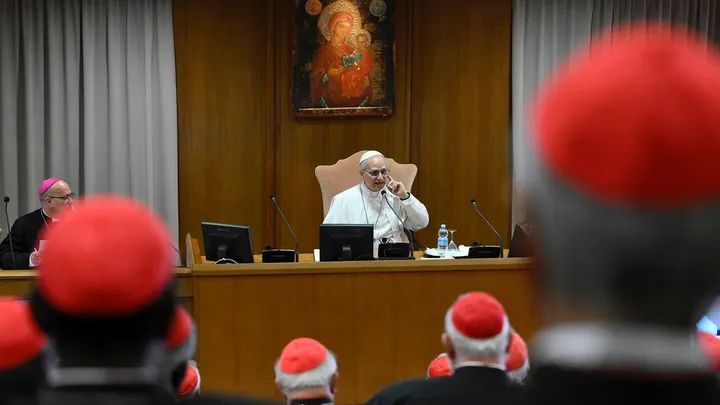
Artificial intelligence poses a growing threat to human dignity, Pope Leo XIV warned in his first address to the College of Cardinals on Saturday. Calling for urgent moral leadership, the newly elected pope urged the Catholic Church to confront this challenge with courage, clarity, and compassion.
Pope Leo XIV, formerly Cardinal Robert Francis Prevost, is the first American to become pope. A former missionary and head of the Dicastery for Bishops, he speaks English, Spanish, and Italian. His election was widely seen as a move toward unity following the death of Pope Francis. His choice of the name “Leo” pays homage to Pope Leo XIII and his emphasis on social justice.
Under Pope Francis, the Vatican had significantly expanded its digital initiatives—revamping media efforts, boosting its social media presence, and co-launching the “Rome Call for AI Ethics” with technology leaders to encourage transparency and accountability in AI development.
Pope Leo XIV affirmed his commitment to continuing this work. He described AI as a transformative force that could reshape labor, social structures, and even human self-understanding. But he stressed that the Church must ensure that people—not profit—remain at the center.
“These are Gospel principles,” he said, “through which the merciful face of the Father has been revealed and continues to be revealed in the Son made man. Let us carry this precious legacy forward with the same hope that springs from faith.”
The pope also cautioned against the distractions of the digital world, urging Catholics to remain rooted in prayer and discernment. Citing Scripture, he reminded listeners that God is often found not in noise or spectacle, but in “the whisper of a gentle breeze” or “the sound of sheer silence.”
Reflecting on the passing of Pope Francis, he called the moment sorrowful but full of grace. Describing the papal transition as a “paschal event”—a spiritual turning point—he expressed gratitude for his predecessor’s life of service and called for renewed commitment to the path set by the Second Vatican Council.
He concluded by urging the Church to embrace listening, dialogue, and a deeper commitment to the poor. His remarks offered a vision of a Church grounded in tradition yet unafraid to meet the future with courage—especially as it confronts technologies that challenge our understanding of humanity itself.
Speaking at the New Synod Hall, Pope Leo XIV reminded the cardinals that the Church has navigated transformative eras before. He likened the rise of AI to the sweeping changes of the 19th-century industrial revolution and emphasized the Church’s role in defending the vulnerable and upholding justice.
“Pope Leo XIII responded to the first industrial revolution with the landmark encyclical Rerum Novarum,” he said. “Now, we must draw on that same tradition of Catholic social teaching to face a new revolution driven by artificial intelligence.”