
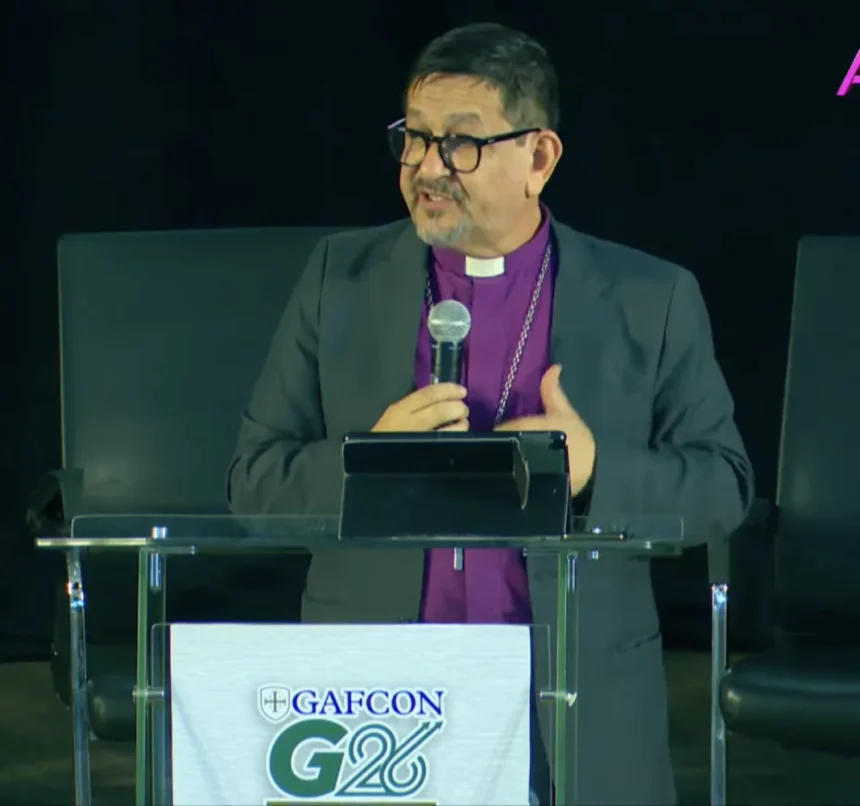
[Abuja, Nigeria] The Rt. Rev. Flavio Adair Torres Soares of Recife told the G26 Conference in Abuja on March 5 that the “so‑called Instruments of Communion” have failed in their stated purpose and cannot be the future foundation of Anglican unity. Instead, he argued, a reordered global Anglican Communion must be explicitly confessional, grounded in Scripture, historic doctrine, and effective discipline rather than in Canterbury‑centred administrative structures.
Speaking on the second day of G26, under the wider theme “Reordering the Communion,” Bishop Adair addressed bishops and leaders drawn from across the Global South and wider Anglican world. His lecture was the fourth in a 12‑part series unpacking why Gafcon and its allies believe that the present crisis requires not cosmetic reform but a structural re‑ordering of Anglicanism’s global life. Adair’s particular brief was to examine the “instruments of communion” and to ask whether they can serve as guardians of the gospel in the 21st century.
Adair began by questioning the language of “instruments of communion” itself. To call something an instrument, he observed, is to suggest that it produces the desired result—in this case, to “guarantee and preserve” the Anglican Communion. But true Christian communion, he insisted, is not generated by any human structure; it is recognised, confessed, and lived under the authority of the Holy Spirit, arising from Scripture, the apostolic faith, and a shared sacramental and moral life. In that sense, structures may serve communion, but they can never create it, and when administrative mechanisms are treated as instruments of communion, “ecclesiological myths” emerge and institutional coordination is confused with spiritual unity.
Adair then rehearsed the history of the four traditional Instruments of Communion: the Archbishop of Canterbury, the Lambeth Conference, the Anglican Consultative Council (ACC), and the Primates’ Meeting. None of these, he pointed out, is apostolic in origin; each is a relatively recent, pragmatic development. Lambeth first met in 1867 as a consultative bishops’ gathering; the ACC was created in 1968; the Primates’ Meeting began in 1978; and Canterbury’s global centrality was shaped in an imperial and post‑imperial context to coordinate autonomous provinces. The original purpose of these bodies, Adair stressed, was to preserve relational unity without creating a magisterium, and they were intentionally designed without supra‑provincial executive or disciplinary authority.
From this history, Adair drew a stark conclusion: the failure of Canterbury‑centred structures is not merely the failure of particular Archbishops but a design failure. The system, as built, could never guarantee doctrinal faithfulness because it lacks the theological and juridical tools needed to guard the gospel. It was created to facilitate coordination and consultation among autonomous churches, not to secure confessional unity or common discipline when deep doctrinal disputes arise. “When structures never had the ability to exercise binding authority,” he argued, “we should not be surprised when they prove incapable of resisting theological revolution.”
Adair located the tipping point of the Communion’s present crisis in and around Lambeth 1998 and Resolution I.10 on human sexuality. That resolution, he observed, articulated the traditional teaching held by the majority of Anglicans worldwide, yet what followed exposed the limits of the Instruments. In the years after 1998, commissions were convened, moratoria recommended, the Windsor Report and Anglican Covenant proposed, and extraordinary Primates’ Meetings held—all without resolving the breach. Out of this process, Adair identified four structural absences: no binding common confession; no supra‑provincial canonical authority; no global mechanism for discipline and repentance; and no clearly defined confessional centre to which all provinces were accountable.
To make the argument clear, Adair cited the experience of Brazil. The Episcopal Anglican Church of Brazil did not receive Lambeth I.10 as authoritative and supported the consecration of Gene Robinson in 2003–2004, even as many in the Communion appealed for restraint. A dissenting diocese that aligned with the 1998 majority and with Windsor’s recommendations found itself marginalised; its bishop and clergy, Adair said, faced discrimination and isolation for upholding the Communion’s stated teaching. No effective global intervention came to their aid, which he presented as a structural demonstration that the Instruments could not secure reception of agreed doctrine or protect orthodox minorities.
From here, Adair contrasted two models of ecclesiology that have been vying for the soul of Anglicanism since at least the late 1990s. On the one hand is a consultative ecclesiology: “we meet, we talk, we issue statements, and we preserve relationships,” even when those relationships conceal deep and unresolved theological divergences. On the other hand is a confessional ecclesiology: “we confess one faith, guard one gospel, and order our common life under Scripture,” accepting that discipline and sometimes visible separation may be required to protect that confession. Without shared authority and common discipline, he argued, communion degenerates into “institutional accommodation,” where unity is reduced to staying at the same table and negotiating lowest‑common‑denominator resolutions.
Adair acknowledged that the language of “rejecting” the Instruments of Communion is strong, but insisted it is not “emotional rhetoric” but a sober historical and ecclesiological judgment. To say the Instruments have failed is not, he said, to break fellowship with the one, holy, catholic, and apostolic Church, nor to create a new, parallel Anglican communion. Rather, it is a declaration of ecclesial continuity grounded in confessional fidelity: “we continue the Anglican Communion precisely insofar as we remain under the authority of Scripture, within the historic faith, and in discipline consistent with that confession.” For Anglicans, he reminded his hearers, continuity has always been fundamentally theological, not geographical.
For roughly 150 years, Adair suggested, Anglican identity was mediated by a simple, functional rule of thumb: “what Canterbury recognises is Anglican.” That era, he said, is now over. In light of recent developments, including the Martyrs’ Day Statement and the Kigali Commitment, the centre of Anglican identity has shifted from geographic recognition to confessional theology. Today, the true centre of communion is not an English see but the Scriptures themselves, as received in the historic formularies and lived out in consistent discipline. Gafcon and its allies therefore claim not to be forming a rival communion but to be re‑ordering the existing one around its original doctrinal core.
Adair insisted that critical evaluation of structures is not rebellion but “a theological and missional responsibility.” If the church exists for the evangelisation of the nations and the salvation of souls, then structures exist to preserve the faith that saves, not to preserve themselves. When structures no longer guard the gospel, he argued, fidelity requires reordering: building a more conciliar, globally representative, and accountable framework that can sustain confessional communion. In line with the wider G26 process in Abuja, Adair thus called for new structures marked by doctrinal clarity, mutual accountability, and shared mission—structures capable of expressing what he described as the “supermajority” of Anglicans who remain committed to the authority of Scripture and the historic teaching of the Church.
Within the broader G26 narrative, Adair’s lecture helps explain why Gafcon leaders now speak of “the future has arrived” and why they have moved to establish new global leadership structures. In Abuja, Gafcon bishops and allies affirmed that Anglican unity “can no longer be based on the so‑called Instruments of Communion” but must be founded on God’s gospel as revealed in the Bible. Adair’s argument provides the theological and historical rationale for that shift: communion, he said, has content, confession, and form, and only structures that serve that doctrinal reality deserve the name Anglican in the years to come
George Conger
Anglican Ink