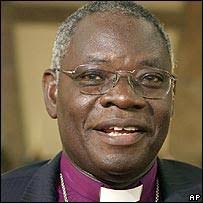


The Most Reverend Timothy Omotayo Olufosoye (March 31, 1917 – 2 November, 1992) holds an enduring place in Nigerian Anglican history as the first Primate of the Church of Nigeria (Anglican Communion).
His election and installation in 1979 marked the dawn of a new era, the Nigerian church’s transition from missionary oversight under the Province of West Africa to full autonomy, with the freedom to chart its own course. In this pioneering role, Olufosoye combined humility with vision, laying a solid foundation for what would later become one of the largest and most influential provinces in the worldwide Anglican Communion.
Born in Ondo town on March 31, 1917, Olufosoye’s roots were deeply planted in the Yoruba heartland. Raised in a devout Anglican family influenced by the Church Missionary Society (CMS), his early life was steeped in Christian discipline and communal service. He first trained and worked as a teacher, a vocation that instilled in him diligence, intellectual curiosity, and a strong ethic of service qualities that later enriched his ministry when he embraced the call to priesthood.
He trained theologically at Melville Hall, Kudeti, Ibadan, one of the foremost Anglican institutions of his time, where he gained the biblical and pastoral grounding that shaped his service for decades. Ordained deacon in 1940 and priest in 1941, he quickly gained recognition for his pastoral zeal, administrative competence, and missionary commitment. In 1959, he was appointed the first Provost of the Cathedral of Ondo, a landmark achievement that symbolized growing confidence in indigenous leadership when foreign missionaries still wielded significant influence. He served there until 1965, further consolidating his reputation as a faithful servant of the church.
That same year, Olufosoye was consecrated the first Nigerian Bishop of Gambia and the Rio Pongas, overseeing a vast jurisdiction covering The Gambia, Senegal, and parts of Guinea. This role exposed him to the challenges of sustaining Anglican witness in diverse cultural landscapes across West Africa. In 1971, he was translated to the Diocese of Ibadan, one of Nigeria’s most prominent sees, where his episcopacy was marked by evangelism, church planting, and strong investment in education and social development. He continued to oversee Gambia for several years alongside Ibadan.
The defining moment of his ministry came on February 24, 1979, when he was installed as the first Primate of the autonomous Church of Nigeria. This historic step gave Nigerian Anglicans the right to elect their leaders and define their mission without external control. Olufosoye approached the role with humility but a firm clarity of purpose. The church would grow, govern itself, and take ownership of its mission. Under his leadership, the number of dioceses expanded from 16 to 27, strengthening Anglican presence across Nigeria.
He prioritized evangelism and rural church planting, setting the stage for the grassroots expansion that later defined Nigerian Anglicanism. He also invested in theological institutions such as Melville Hall and Trinity College, Umuahia, ensuring that the growing church was served by well-trained indigenous clergy. Internationally, he gave the Church of Nigeria a confident voice at the Anglican Consultative Council and Lambeth Conferences, where he projected the priorities of a self-reliant African church.
After seven fruitful years, Olufosoye retired in December 1986 at age 69, handing leadership to Archbishop Joseph Abiodun Adetiloye. His retirement was marked by gratitude from clergy and laity, who recognized the stability, vision, and expansion he had given the church during its formative years.
He passed away on 2 November 1992, aged 85. His funeral drew tributes across Nigeria and West Africa, with church leaders hailing him as the trailblazer who gave the Nigerian church its autonomy and enduring identity. His legacy lives not only in the Church of Nigeria but also in institutions and parishes that bear his name, such as the Anglican churches in Ogba, Lagos, and in his hometown of Ondo. His personal reflections were preserved in his book, My Memoirs, which offers a window into the life and mind of this remarkable leader.
Though less documented than some of his successors, Olufosoye’s impact remains undeniable. He was the leader who gave the Church of Nigeria its autonomy, direction, and foundation, ensuring that generations after him would build on the sturdy walls he first laid.