
INTRODUCTION
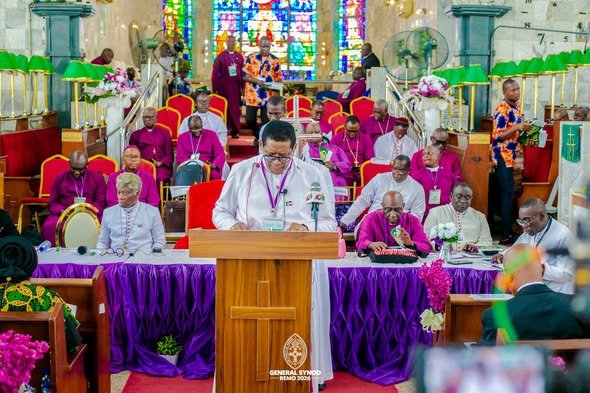
The 15th General Synod of the Church of Nigeria (Anglican Communion) met under the guidance of the Holy Spirit at Our Saviour’s Church, Ikenne, Diocese of Remo, Ogun State, from Monday, 14th – Friday, 18th September, 2026. The Synod, with the theme: The Priesthood of All Believers: Equipping God’s People for the Work of Ministry (1 Peter 2:4–5, 9–10), was presided by His Grace, the Most Rev’d Henry Chukwudum Ndukuba, DD (Archbishop, Metropolitan and Primate of All Nigeria).
There were 142 Bishops, 199 Clergy, and 145 members of the Laity in the rolls of the Houses. Also at the opening ceremony were the wife of the Primate of the Church of Nigeria, Mrs. Angela Bberechukwu Ndukuba (President of Women’s and Girls’ Organizations); His Excellency Prince Adedapo Abiodun, MFR, CON (The Governor of Ogun State); the Most Rev’d Dr. David Onuoha (President of the Christian Council of Nigeria); and other eminent and distinguished personalities. The General Secretary of Global Anglican Communion, Rt. Rev’d Paul Donison; and the former Primates of the Church of Nigeria, the Most Rev’d Dr. Peter Jasper Akinola, CON, and the Most Rev’d Dr. Nicholas D. Okoh sent in their goodwill messages.
At the end of the General Synod, the following communiqué was issued:
THE THEME OF THE 15TH GENERAL SYNOD
Guided by the theme, The Priesthood of All Believers: Equipping God’s People for the Work of Ministry (1 Peter 2:4–5, 9–10), the General Synod affirmed that the Priesthood of All Believers is derived from Jesus Christ, through faith and the Holy Spirit, calling every Christian to offer acceptable worship and participate actively in Christ’s mission. It emphasized moving beyond clergy-centred ministry to intentionally equip, empower, and mobilize all members for Christian service, rooted in fellowship and family life. This requires intentional discipleship, sound biblical teaching, spiritual formation, practical training, and resistance to paganism and revisionist agenda. The Church is encouraged to strengthen volunteerism, collaborative leadership, evangelism, compassionate service, and effective witness. An empowered lay ministry, partnering with ordained clergy, is essential for Church growth, mission and impactful nation building.
STATE OF THE NATION
- Insecurity
The General Synod views with great concern the continued problem of insecurity in our nation. Banditry, kidnapping and killings continue unabated in different parts of the country. While praising the Federal Government for some gains recently achieved in rescuing kidnapped people especially school children and their teachers in some States in the country and the deployment of forest guards, it urges Government at all levels to do more in the protection of the lives of the citizens. Synod recommends more of the use of intelligence gathering, covering the ungoverned spaces in the land, and recovering territories under the control of the terrorists, thus becoming proactive rather than reactive in security matters.
- 2027 General Elections
As Nigeria approaches the 2027 General Elections, Synod calls on all Nigerians, political leaders and parties to place national unity, peace and the common good above partisan interests. Political actors and citizens should reject hate speech, violence, intimidation, vote-buying and misinformation, embracing issue-based campaigns and peaceful participation. Synod urges citizens to exercise their civic responsibilities conscientiously and respect lawful electoral processes and outcomes. The Independent National Electoral Commission (INEC) is called upon to uphold neutrality, transparency and credibility in the conduct of the elections, while the Judiciary is urged to safeguard its integrity by acting independently and impartially in election-related matters. Political differences should never become grounds for hatred, violence or the breakdown of national unity.
- Health Sector
Synod expresses deep concern over the challenges confronting Nigeria’s health sector, particularly the accessibility, affordability and quality of healthcare available to Nigerians. Synod calls for renewed commitment to strengthening public health institutions, equipping healthcare facilities, supporting medical and health workers, and ensuring that no Nigerian is denied essential care because of poverty or circumstance. Synod further urges greater attention to preventive healthcare, maternal and child health, mental and community health, and the welfare of vulnerable persons. As a Church committed to the dignity and sanctity of human life, Synod encourages government, healthcare providers, faith communities and other stakeholders to work together towards a healthcare system that is compassionate, equitable, accountable and responsive to the needs of all.
- Education
Synod commends Federal and State Governments for efforts to strengthen Nigeria’s education sector through improved access, teacher development, skills acquisition, digital learning, and technical and vocational education.
However, inadequate funding, out-of-school children, insecurity, poor learning outcomes, inadequate infrastructure, teacher shortages, and insufficient professional development remain serious concerns. Government should prioritize sustained education funding, strengthen accountability, improve teacher recruitment, remuneration and training, expand safe and inclusive basic education, integrate vocational and digital skills, and make tertiary education accessible and affordable. Synod also calls for stronger collaboration among government, faith-based organizations, communities, and other stakeholders to build an education system that produces competent, skilled, morally grounded, and responsible citizens.
5 The Nigeria Economy
Synod notes modest economic improvement but remains concerned about persistent inflation, unemployment, weak electricity supply and rising fuel prices, which have severely reduced household purchasing power and increased the cost of transportation, food and basic necessities. Synod urges Government to stabilize and reduce the prices of petrol, diesel and kerosene to enable households and businesses plan sustainably. It further calls for a clear, transparent framework for licensed modular refineries, ensuring environmental and safety compliance, lawful revenue, job creation and equitable benefits for Niger Delta host communities.
- Xenophobic and Racial Attacks
Synod expresses deep concern over recurring incidents of xenophobia, Afrophobia, racial discrimination and marginalization in various parts of the world, particularly the recent attacks and violence against Nigerians in South Africa. Synod condemns all forms of violence, discrimination and hostility based on nationality or race, affirming that every human being is created in the image of God and is entitled to dignity, security and justice. Synod therefore calls on the Governments of Nigeria and South Africa to strengthen dialogue and bilateral relations, building on the historic solidarity between both nations during the struggle against apartheid. Both Governments should work collaboratively to promote peaceful coexistence, mutual respect, the protection of citizens and the enduring bonds of African brotherhood. Nigerians in the diaspora are, however, encouraged to maintain proper documentation and strictly comply with the immigration laws of their host countries.
- Agriculture and Food Security
Synod expresses grave concern over Nigeria’s deepening food crisis. With over 220 million people, the nation faces its worst harvest in decades due to conflict, climate change, hyperinflation, and high farming costs. International and Humanitarian Organizations project that many people, particularly in the North East and North-Central states will face severe hunger by the end of 2026. Key drivers include insecurity, fertilizer costs, and loan rates up to 36%. We call on government to restore farm security, invest substantially in mechanized farming to boost production, provide single-digit loans, subsidize inputs transparently, reduce post-harvest losses, modernize grazing, expand fisheries, encourage food storage, and establish a transparent Agriculture Trust Fund. Farmers must be empowered to feed the nation.
- Drugs and Substance Abuse
The General Synod expresses grave concern over the escalating menace of drug trafficking, substance abuse and addiction in Nigeria, particularly among young people. This scourge is increasingly associated with violent crime, insecurity, gang activity and harm to mental health, family wellbeing and the economy. The Synod calls on government and relevant agencies to intensify public education, prevention, enforcement, rehabilitation and reintegration, with stronger collaboration among Government, schools, families, communities, the Church and relevant agencies. It further calls for consideration of a constitutional amendment requiring mandatory, credible and periodic drug and substance-abuse testing for serving public officers and persons seeking elective or appointive public office and appropriate sanctions for verified violations.
- Cost of Governance, Corruption and Accountability
Synod calls on all levels of government to urgently reduce the high cost of governance by eliminating administrative waste, redundant political appointments and non-essential expenditure. Savings should be redirected to education, healthcare, infrastructure, security and social welfare. Synod urges the full and transparent implementation of the Oronsaye Report to eliminate duplication and promote efficiency in public institutions. It further calls for stronger anti-corruption measures through systemic reforms, open budgeting, transparent procurement and effective fiscal oversight. Public officials are reminded that they are accountable to God, the Constitution and the Nigerian people, and must diligently and transparently manage public resources.
10 National Unity
Synod calls on all Nigerians to make national unity, peace and mutual respect a priority, resisting attempts to divide the nation along ethnic, religious, regional or political lines. Nigeria’s Constitution upholds the secularity of the nation amid its diverse religious, ethnic and cultural identities, and this constitutional character must be respected and preserved as an essential foundation for peaceful coexistence. In this regard, the continuation of a Muslim-Muslim presidential ticket by a leading political party, as well as the unrestrained interpretations advanced by some bigots, should not be allowed to undermine Nigeria’s delicate unity or the established balancing mechanisms that have helped to accommodate its diversity. Diversity should be a source of strength, not conflict. Synod is also concerned by reports of qualified Christian youths allegedly being denied admission to professional courses in some Federal universities in Northern Nigeria on religious grounds.
It calls for investigation and strict adherence to merit, fairness and lawful admission criteria. Political and religious differences should never foster discrimination or violence. Synod urges leaders and citizens to promote justice, dialogue and equal opportunity, recognizing Nigeria as our common home, and calls on all to resist every attempt to sacrifice the nation’s unity and constitutional sensibilities to narrow political interests or adventurism.
- Technology, Artificial Intelligence and Moral Challenges of the Digital Age
Synod recognizes the immense potential of technology and Artificial Intelligence (AI) to advance human development, education, healthcare, communication, economic opportunities and the proclamation of the Gospel. However, it expresses concern over the moral and social challenges of the digital age, including misinformation, hate speech, cybercrime, invasion of privacy, exploitation of children and vulnerable persons, digital addiction, academic dishonesty, deepfakes, manipulation and deception. The Synod calls for ethical, responsible and lawful use of digital technologies, affirming that technological possibility does not necessarily constitute moral permissibility. It urges individuals, families, educators, developers and governments to uphold human dignity, critical thinking, moral responsibility, compassion, spiritual discernment and the common good.
CONCLUSION
The 15th General Synod reaffirms the calling of the Church of Nigeria to be a faithful witness to Christ and a responsible instrument of transformation in Church and society. In the spirit of the priesthood of all believers, Synod calls every Christian to discover, develop and deploy their God-given gifts in the service of God and humanity. Synod urges collective commitment to truth, justice, peace, accountability and the common good; and remains hopeful that, by God’s grace and with renewed faith, responsible citizenship through united, sacrificial action, Nigeria can overcome her present challenges, fulfil her God-given potential, and secure a prosperous future for generations to come.
The Ven. Festus Chukwunyere Opara, PhD
General Secretary, Church of Nigeria
The Most Rev’d Blessing C. Enyindah, PhD
Dean, Church of Nigeria
The Most Rev’d Henry Chukwudum Ndukuba, DD
Archbishop, Metropolitan and Primate of All Nigeria