
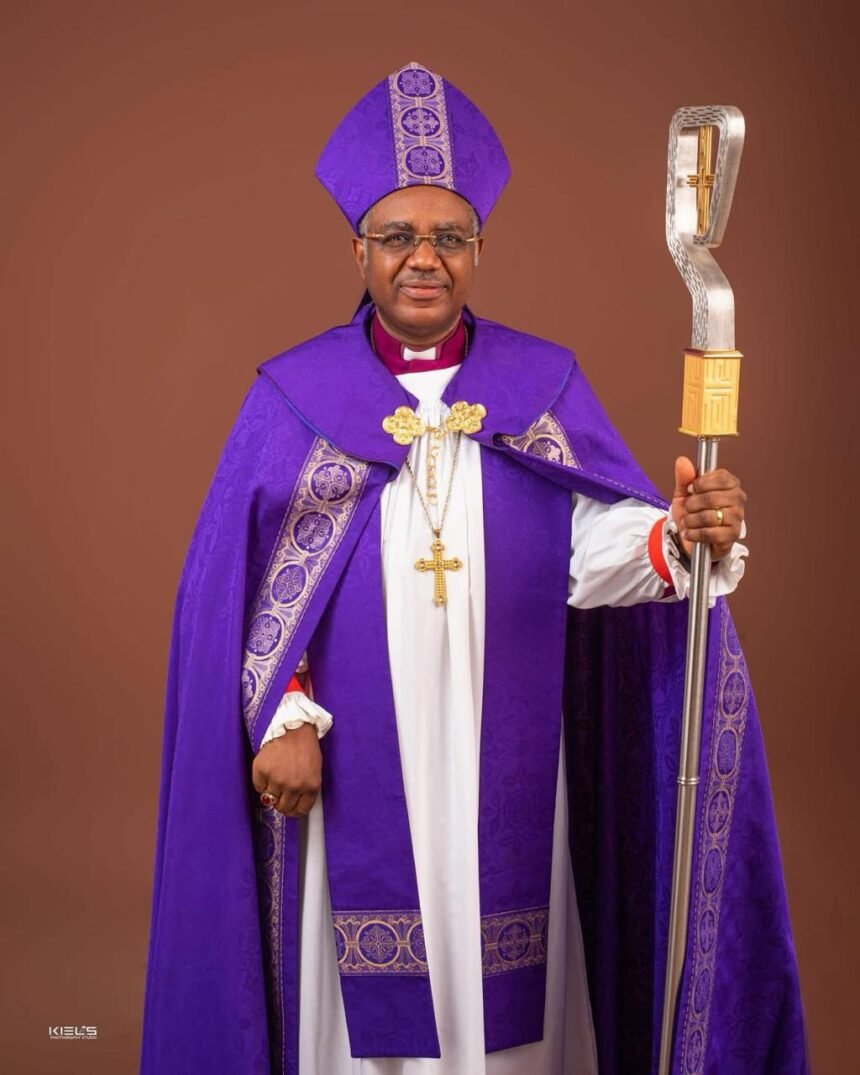
Korede Akintunde in ENUGU —The Rt. Revd. Dr. Christian O. Onyia, Bishop of Nike Diocese has addressed a significant cultural and theological point regarding the hierarchy of honors in Igbo land. He explicitly remarked that the Investiture into the Order of Knighthood (KSC) carries a spiritual weight and eternal significance that transcends traditional local titles, such as the Ozo title.
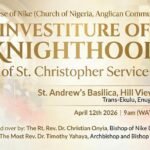
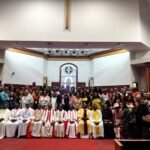
He made this remark during the solemn investiture service of 29 Men and Women into the Order of Knighthood of St. Cristopher, (KSC) on Sunday, April 12, 2026, which took place at the St. Andrew’s Basilica in Hillview Trans-Ekulu, Enugu.
Bishop Onyia emphasized that while the Ozo title is a respected mark of traditional achievement and social standing within Igbo culture, the Knighthood is an enlistment into the army of the King of Kings. He noted that the source of the Knighthood is divine, whereas traditional titles are rooted in earthly heritage.
The bishop noted that a Knight is “greater and bigger” in honor because of the covenantal nature of the office. He added that it will be an insult for him to be contesting or called to be the Governor of Enugu State which is a lower office to that of a bishop he currently occupies, as he reminded the congregation that they (political offices) all answer to his office as the spiritual head.
He highlighted several key distinctions between being a Knight and other traditional titles: while an Ozo titleholder traditionally serves their immediate community or clan, a Knight is called to serve the global body of Christ and defend the Gospel across all boundaries. He reminded the Knights that the “sword” of a Knight is the Word of God, and their “title” is written in the Book of Life, offering a spiritual authority that traditional rites cannot confer.
The remarks were particularly poignant given the complex relationship between Christianity and traditional Igbo customs where many who are Knights still go to get the local titles.
Bishop Onyia urged the new knights not to allow their Christian commitment to be overshadowed by cultural expectations. He charged them to prioritize their vows to the Church above any traditional obligations that might conflict with biblical principles, asserting that their dedication to Christ should be the most visible aspect of their public lives.
The newly invested knights are now expected to serve as models of humility, steadfastness and active Christian witness in their homes, parishes and wider communities.
For many in attendance, the occasion was both inspiring and timely. In a society hungry for credible examples of integrity and service, the Diocese of Nike’s celebration of knighthood offered a compelling portrait of leadership rooted not in power, but in faith. It was a reminder that the Church continues to recognize and raise individuals whose calling goes beyond personal achievement to communal responsibility and spiritual influence.
As the ceremony concluded, one truth stood clearly above all else: the investiture was not the end of a journey, but the beginning of a greater one. For the newly honored knights, the title now carries a sacred expectation — to live as defenders of Christian values, faithful servants of the Church and agents of hope in a changing world.