

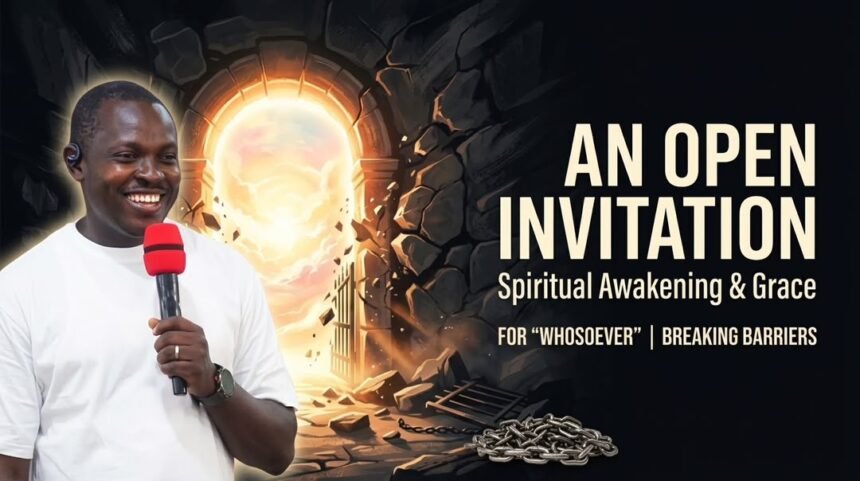
I have personally taken note of this words used interchangeably – “Whosoever”, “Whoever”, “Anyone” especially in the bible and even in normal official language or document and I will like to share this perspectives.
Historically, institutional religion flourishes by constructing gates, managing credentials, and maintaining exclusivity. It creates clear boundaries between insiders and outsiders, defining who belongs based on heritage, ritual, or perfection. Religion asks: Are you qualified? Do you meet the criteria?
Then comes a single, explosive word that shatters every gate ever built by human hands: “Whosoever.”
Used 183 times in the King James Bible, “whosoever” is the ultimate equalizer. It does not say “whosoever is holy,” “whosoever is born into the right lineage,” or “whosoever has their life completely together.” It says whosoever.
Yet, we often misunderstand this radical word. We mistake “whosoever” for a pass to stay as we are—a passive ticket into a spiritual country club. In reality, “whosoever” does not eliminate expectations; it shifts the paradigm from religious compliance to active, heart-driven obedience.
Let me share just 4/5 few areas it was used out of the over 180 times in the bible. The last one is very important!.
- Religion Needs Prerequisites; Obedience Needs a Choice
Religion tells you that you must clean yourself up before you can step through the door. It measures your standing by how closely you adhere to an external checklist of rules. Under a religious framework, obedience is a transaction: I follow the rules so that I will be accepted.
“Whosoever” flips this dynamic entirely.
When Scripture says, “Whosoever shall call upon the name of the Lord shall be saved” (Romans 10:13), it establishes that acceptance comes first. The door is thrown wide open to anyone willing to walk through it.
Because the invitation is universal, what follows is no longer about fulfilling religious rituals to gain standing—it is about personal response. You are no longer trying to earn a place; you are choosing to align your life with the One who invited you in. Religion demands performance to earn love; “whosoever” offers love that demands a response. - “Whosoever” Removes Excuses and Enforces Accountability
It is easy to hide behind religion. You can follow rituals, wear the right clothes, and say the right phrases while keeping your heart completely detached. Religion allows you to blame your lineage, your upbringing, or your environment for your spiritual condition.
“Whosoever” leaves nowhere to hide.
By removing every barrier of entry, it also removes every excuse for inaction. If the invitation is extended to everyone, then whether you step into truth or remain in darkness rests entirely on your personal willingness to obey.
Notice how Jesus uses the word when talking about action:
“Therefore whosoever heareth these sayings of mine, and doeth them, I will liken him unto a wise man, which built his house upon a rock.” — Matthew 7:24
Jesus did not say “whosoever goes to the temple” or “whosoever identifies with the right group.” He tied wisdom and survival directly to hearing and doing. “Whosoever” makes obedience an individual responsibility. You cannot ride the coattails of a community, a denomination, or a family legacy. The word demands your response. - The Shift from External Rule to Internal Alignment
Religion focuses on external boundary markers: Do not touch, do not eat, do not go. It creates a culture of compliance driven by the fear of exclusion.
Obedience born from “whosoever” is entirely different—it is driven by devotion. When you realize that the Creator of the universe extended a personal, unearned invitation directly to you, obedience ceases to be a burden and becomes a natural expression of gratitude.
Consider the profound paradox Jesus introduces with the word:
“For whosoever will save his life shall lose it: and whosoever will lose his life for my sake shall find it.” — Matthew 16:25
This is not a religious rule; it is a foundational law of human flourishing. Religion tries to preserve self-importance, moral superiority, and control. True obedience requires surrendering control—losing your life, your pride, and your self-righteousness—to find real freedom. - John 3:16 and the Mandate of Active Trust: The Blank Check of Grace Demands the Signature of Surrender.
No discussion of this word can bypass the polar star of the New Testament—the verse that forms the bedrock of Christian theology:
“For God so loved the world, that he gave his only begotten Son, that whosoever believeth in him should not perish, but have everlasting life.”— John 3:16
Religion looks at John 3:16 and attempts to ritualize it. It turns belief into an intellectual checkbox or a static creed recited by rote memory. But the biblical concept of belief (pisteuo in the original Greek) is not passive agreement—it is entrustment, reliance, and loyalty in action.
Here lies the profound tension of John 3:16: the universality of the offer does not diminish the gravity of the requirement.
The invitation is a “blank check”—open to every tribe, tongue, moral failure, and outcast. It cancels every pedigree. But a blank check remains utterly useless until it is signed and cashed. In John 3:16, “whosoever” is the universal opening, but “believeth” is the binding action. You cannot claim the promise while clinging to your own autonomy.
Religion allows you to profess belief while keeping your life under your own management. The “whosoever” of John 3:16 demands that you hand over the steering wheel. It teaches that grace is unconditional in its availability, but deeply demanding in its claim on your life.
Food for thought
“Whosoever” is not an invitation to passive spectator religion. It is a summons to action.
It tells you that your past does not disqualify you, your background does not limit you, and your mistakes do not define you. But it also tells you that the moment you hear the invitation, the responsibility shifts to you.
Religion asks, “Who is allowed in?” “Whosoever” answers, “Everyone.”
And in doing so, it poses the only question that truly matters: Now that the door is open to you, will you obey and answer?
Korede Akintunde, ANIPR writing from Abuja, Nigeria.
27th September, 2027.