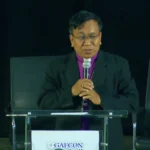


[Abuja, Nigeria] The Most Rev. Glenn Davies delivered the eighth of 12 talks at the G26 conference in Abuja, Nigeria, on March 6, 2026, urging Anglican provinces to break canonical ties with the See of Canterbury by amending constitutions to prioritize Reformation formularies and the Jerusalem Declaration instead.
Titled “Canonical Alignment and Differentiation,” his address called on Anglican provinces to amend constitutions severing ties to the See of Canterbury, aligning instead with Reformation formularies and the Jerusalem Declaration.
Davies traced Anglican canon law back to the early church’s Jerusalem Council in Acts 15, which guarded gospel unity against threats like debates over Gentile inclusion. Post-apostolic ecumenical councils addressed biblical fidelity in much the same way, a pattern echoed during the 16th-century Reformation when Thomas Cranmer reformed the corrupt Church of Rome through the 39 Articles, the Book of Common Prayer, and planned canons finally completed in 1604 after his martyrdom. Colonial churches adopted these standards as the British Empire expanded, and the 1867 Lambeth Conference under Archbishop Charles Longley affirmed provinces bound together by shared commitment to Scripture, liturgy, and formularies.
As colonies gained independence, churches such as the U.S. Episcopal Church in 1789, New Zealand in 1857, and Australia in 1872 established their own autonomous general synods, loosening formal links with England while often retaining sentimental references to communion with Canterbury. This made sense when the See upheld orthodoxy, Davies argued, but constitutions must now reflect a changed reality: the Church of England’s drift since 1998, including its 2023 authorization of prayers blessing same-sex couples, directly defies Lambeth Resolution I.10’s clear statement that homosexual practice is incompatible with Scripture. Provincial doctrinal foundations—the Bible as supreme authority, the 39 Articles, and the 1662 Prayer Book—demand that canons actively guard the gospel amid growing revisionism.
Davies sharply critiqued the Canterbury-led Instruments of Communion for their failure after the 2003 consecration of Gene Robinson, a development that prompted GAFCON’s launch in 2008 and the ongoing reordering of Anglicanism now celebrated at G26 through the “Martyrs’ Day” statement, likely tied to the Abuja Affirmation. Lambeth 2022’s Calls effectively made I.10 optional, prioritizing vague “walking together” over doctrinal fidelity and redefining Anglican identity by fellowship with Instruments rather than Scripture—what Davies called a “vacuous” arrangement that accommodates the blessing of sin. He dismissed schism accusations by invoking 16th-century reformers like John Jewel, insisting that Global Anglicans are reforming the Communion from within, just as Cranmer rejected Rome without leaving the one holy catholic and apostolic church.
Turning to practical steps, Davies urged provinces to follow Nigeria’s 2005 precedent in redefining communion not by Canterbury but by adherence to historic faith, a path taken by ACNA, the Anglican Church in Brazil, and extra-provincial dioceses recognized by GAFCON Primates. The Martyrs’ Day statement invites all orthodox provinces to participate via assent to the 2008 Jerusalem Declaration—whether by synod resolution, constitutional amendment, or parish action—despite legal or structural hurdles in mixed provinces. Patience is essential, he said, but so is clarity for mission: “If the trumpet does not sound a clear call, who will get ready for battle?”
In defining true Anglican identity, Davies paraphrased Paul to assert that not all who claim the name are Anglican, just as not all Israel was Israel. The Global Anglican Communion inherits Cranmer’s legacy of scriptural supremacy, unbound by a revisionist Canterbury—”We are not leaving the Anglican Communion; we are reforming it”—and shares Holy Eucharist with all who affirm the Jerusalem Declaration as the standard of orthodoxy worldwide.
March 7, 2026
George Conger